

20 de febrero de 2013 | Informes especiales | Agua | Género | Industrias extractivas
Guardians of the lakes
Peru: testimonies of community members resisting the Conga mining project in Cajamarca
Descargar: MP3 (3.8 MB)
The long-standing struggle by peasant and indigenous populations in Peru against the Conga mining project has grown exponentially and there are plans to conduct a community consultation this year on the viability of the project.
This is the largest gold extraction project in South America, where the main company involved is Yanacocha, owned by Newmont Mining Corporation (51.35% of shares) based in Denver, US; Peruvian Cía. de Minas Buenaventura (43.65%) and the International Finance Corporations (IFC) (5%).
The project is located in Cajamarca, around 800 kilometers northeast of Lima, the capital city of the country, in an area bordered by four basins: Quebrada Honda, Río Chonta, Río Porcón and Río Rejo.
One of the areas most affected by this mining project is El Tambo, a region with a strong presence of peasants who produce basic foods such as potatoes, milk and maize.
Friends and enemies
Manuel Ramos Campos, a member of El Tambo community told Real World Radio that the Conga project will result in the disappearance of over 27 lakes in 67 hectares, including two important rivers of the region. Manuel is in charge of the organization El Tambo Defense Front and denounced that the company is looking to replace natural water sources with artificial reservoirs.
“There isn‘t anywhere in the world where reservoirs replace natural lakes”, said Manuel, who faces 33 legal demands due to his rejection to the installation of mines and their effects.
“With this struggle we’ve achieved the unity of all peoples and communities. And what’s more important: we’ve learned to know our friends and our enemies”, said Manuel. The Peruvian peasant believes that there are many “Congas” in the country and the rest of Latin America.
Permanent Surveillance
The peasants have organized their own surveillance system on the lakes that will be affected by the project when the state of emergency declared in 2012 by Peruvian President Ollanta Humala, in response to the increasing mobilizations, was lifted.
The organizations are keeping an eye on the movement of heavy machines of the mining companies around the lakes.
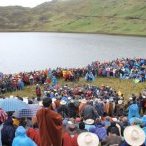
Thus, they formed the “guardians of the lake” movement, where hundreds of men and women guard the area in shifts in order to avoid the advance of the works.
Vilma Rosa Palma, a peasant leader of the resistance to mining, also provided her testimony on the current situation of this conflict and described the strong repression against the communities during the state of emergency.
In particular, Vilma said that the women have played a key role in a resistance that will continue. “Now, women are organizing the shifts so that we are the exclusive guardians of the lake”, she said.
Vilma was motivated to struggle against Conga because she wanted to leave her children a "life heritage" and for that reason, the water of the lakes is essential.
Interviews conducted in a recent tour in Peru by the member of COECOCEIBA-Friends of the Earth Costa Rica, Grace Garcia
Photo: peru21.pe